


On 14 August 2018, at 11:36 in the morning, during a violent thunderstorm over the city of Genoa, a section of the Polcevera Viaduct, more than two hundred metres long, collapsed into the riverbed of the Polcevera and the industrial yards beside it. The fall killed forty-three people and severed one of Italy's busiest motorway corridors at a single, catastrophic stroke.
The viaduct, formally the Viadotto Polcevera and informally the Ponte Morandi, had carried the A10 motorway across the Polcevera valley since September 1967. It was the work of Riccardo Morandi, the Roman engineer who, in the 1950s and 1960s, had built more long-span prestressed-concrete cable-stayed bridges than perhaps any engineer in the world.
The Polcevera was his most ambitious city work. It was also, eventually, the most consequential structural failure of the early twenty-first century in Europe. This is a study of both.
The bridge
The Polcevera Viaduct was a road viaduct 1,182 metres long crossing the Polcevera River and the surrounding industrial valley in western Genoa. The deck ran roughly 45 metres above the valley floor, with the urban grid of the city - factories, railway yards, the river itself, the SP1 road, and a dense pattern of housing - passing underneath.
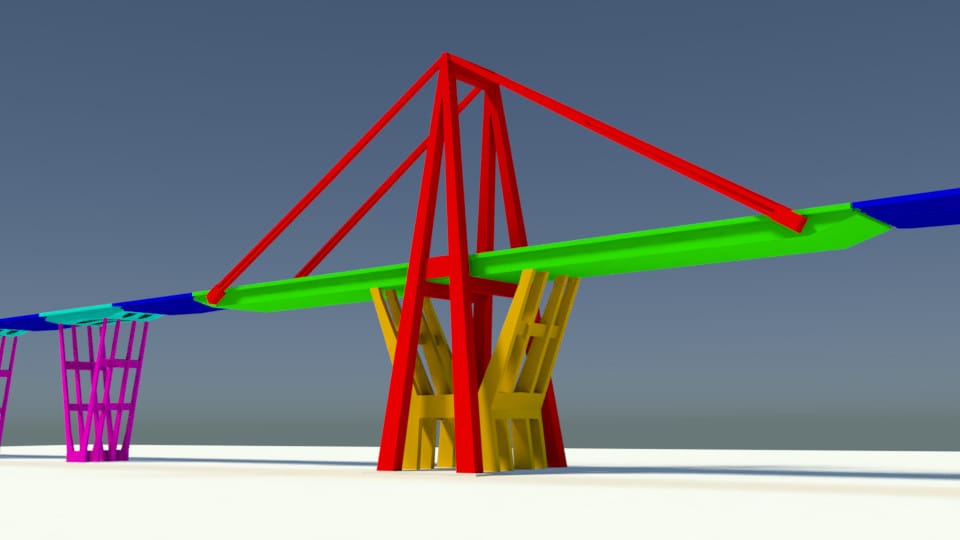
The structural ambition was concentrated in three cable-stayed pylons, each rising to about 90 metres, spaced along the central section of the crossing. Each pylon carried a discrete cable-stayed system: the deck running across the valley was hung from sparse sets of stays attached to the top of an inverted-V antenna at each pylon. The maximum span between adjacent pylons was about 210 metres.
The approach viaducts on either side, of conventional prestressed-concrete construction, made up the rest of the 1.18-kilometre length.
It was an industrial bridge first and a civic monument second. It was not photogenic in the way the Salginatobel or the Sunniberg are. It carried the city's working traffic, and the through-traffic between Italy and France, for half a century.
The idea
What made the Polcevera unmistakable as Morandi's was the stay system. Morandi did not use exposed steel cables in the manner that became standard for cable-stayed bridges from the 1970s onwards. Instead, each stay was a thin reinforced and prestressed concrete shell cast around steel cables.