


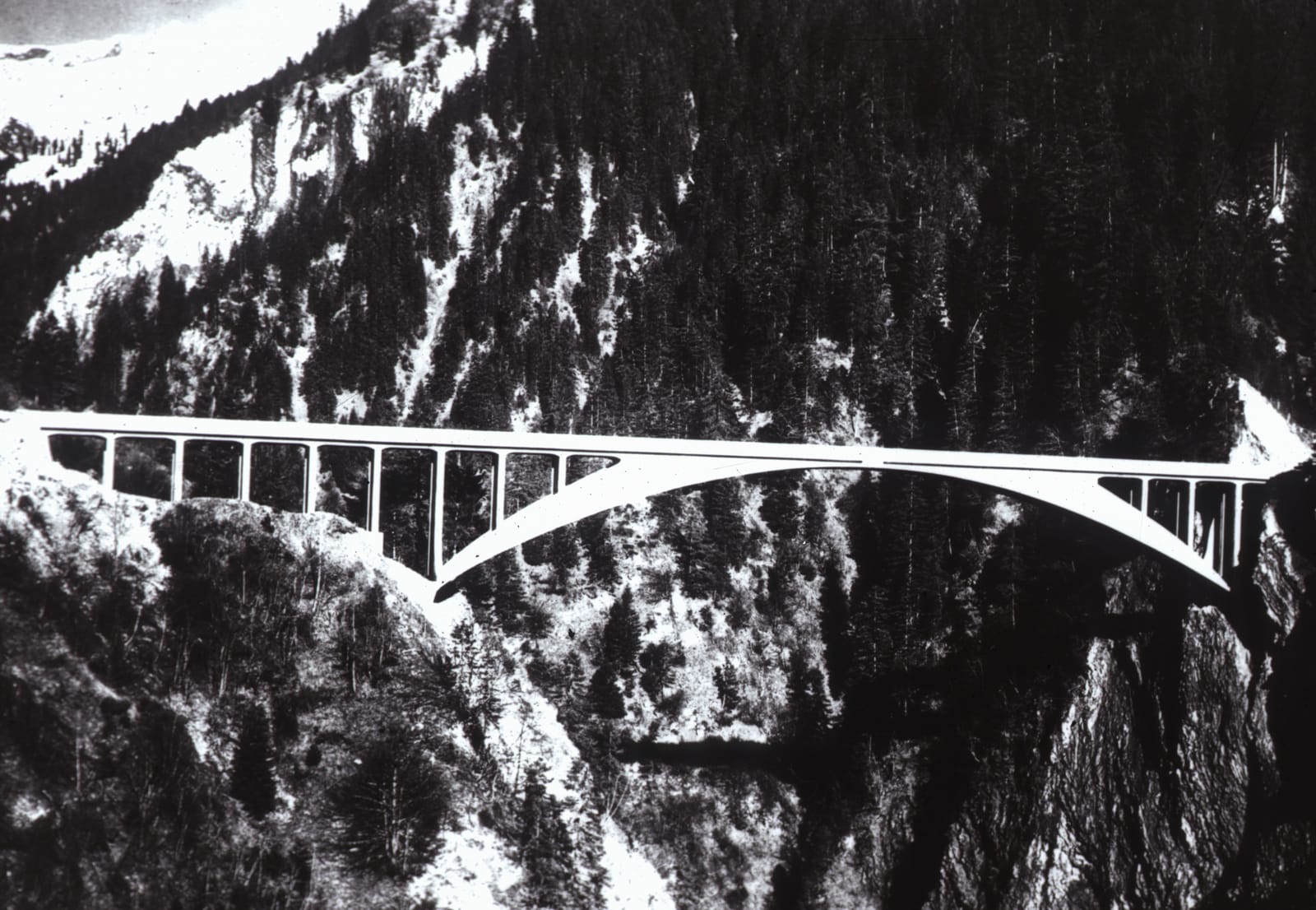
The Salginatobel Bridge spans a 90-metre alpine ravine in the Prättigau valley, in canton Graubünden. The arch is hollow, the cross-section thinner at the crown than at the abutments, and the whole structure reads its own load path from the side. It opened in 1930.
It was won by competition: nineteen designs were tendered, and the cheapest came from a Swiss engineer named Robert Maillart, who was in his late fifties and working out of a small office in Geneva, where he had been ever since losing his Russian practice in the Revolution a decade earlier. The contractor was Florian Prader of Zürich. The bridge was the simplest and the slimmest of all the entries. It cost less. It looks like it costs less.
That is the bridge. It is also the entire conversation we are going to have, ninety years later, on a website called structural.art.
The man
Maillart was born in Bern in 1872. He went to the ETH Zürich and graduated in 1894 - a pupil of Wilhelm Ritter, the engineering professor who eight years later would teach Othmar Ammann too. There is a thread of generations here that we will come back to often on this site.
He spent his twenties and thirties grinding through ordinary work - the cantonal engineer's office in Bern, a partnership with Pümpin & Herzog, then his own firm Maillart & Cie. He patented things. He built bridges nobody noticed.
Then, in 1908, he invented the mushroom slab. The patent - number 46 928 - was granted on 20 January 1909, and the first mushroom-slab building was completed in 1910: the Giesshübelstrasse warehouse in Zürich, near the train tracks, still standing and still in use. The system described reinforced-concrete flooring without beams, with column heads flared into capitals so the punching shear smears into the slab. More than fifty buildings used the system in his lifetime; conceptually, every flat-plate concrete office building you have ever walked into is descended from it.
In 1912 he moved his practice to Russia, where he ran a substantial business building factories, warehouses, and bridges in Kharkov, Riga, and St. Petersburg. In 1916 his wife died. In 1917 the Revolution and the nationalisation of assets took everything else. He arrived back in Geneva on 25 March 1919 - a widower, with three children and a wall of debts to Swiss banks - and never recovered the wealth he had had before the war.
He spent the next twenty-one years working alone. First in Geneva, later opening offices in Bern and Zürich. He took jobs other engineers would not bother with: bridges over alpine ravines, mushroom-column factories, once a six-centimetre-thick concrete shell for a pavilion that would last only as long as an exhibition.
That is the part of the biography you have to know. Maillart was cheap. He had to be. He was hired because his designs cost less than the alternatives. The reason his bridges look the way they do is that they had to come in under the next bid; the elegance is what is left over after you have taken everything out you did not need.
The work
The Salginatobel Bridge is the most photographed of his bridges, and the photographs lie a little. They make it look monumental. The actual structure is slim - almost a sketch in concrete.
The total length is 133 metres; the main arch spans 90 metres. The arch is hollow - a long thin-walled box bent into a curve - and its section is shallower at the crown than at the abutments, where the thrust is greatest. The deck above is rigid; the arch beneath is delicate; the whole thing leans into the gorge as if it had grown there.
From the abutment, the soffit reads its own load. Where the arch is thin, there is no force to be carried. Where the deck meets the arch, the section thickens. The form is the calculation.
When Max Bill wrote the first monograph on Maillart in 1949, he framed the bridges as constructive art - meaning: you cannot take anything away. The shape is not decoration. The shape is the engineering, made visible.
One detail is rarely covered in standard accounts. The 1929 timber falsework that held the arch up while the concrete cured was hand-built by a Graubünden carpenter named Richard Coray - itself a remarkable structure, all timber lattice spanning the same gorge for one summer. Photographs of it survive at the ETH-Bibliothek e-Pics archive. The bridge you know is the second structure to span the Salgina gorge. The first was Coray's, and it was extraordinary.
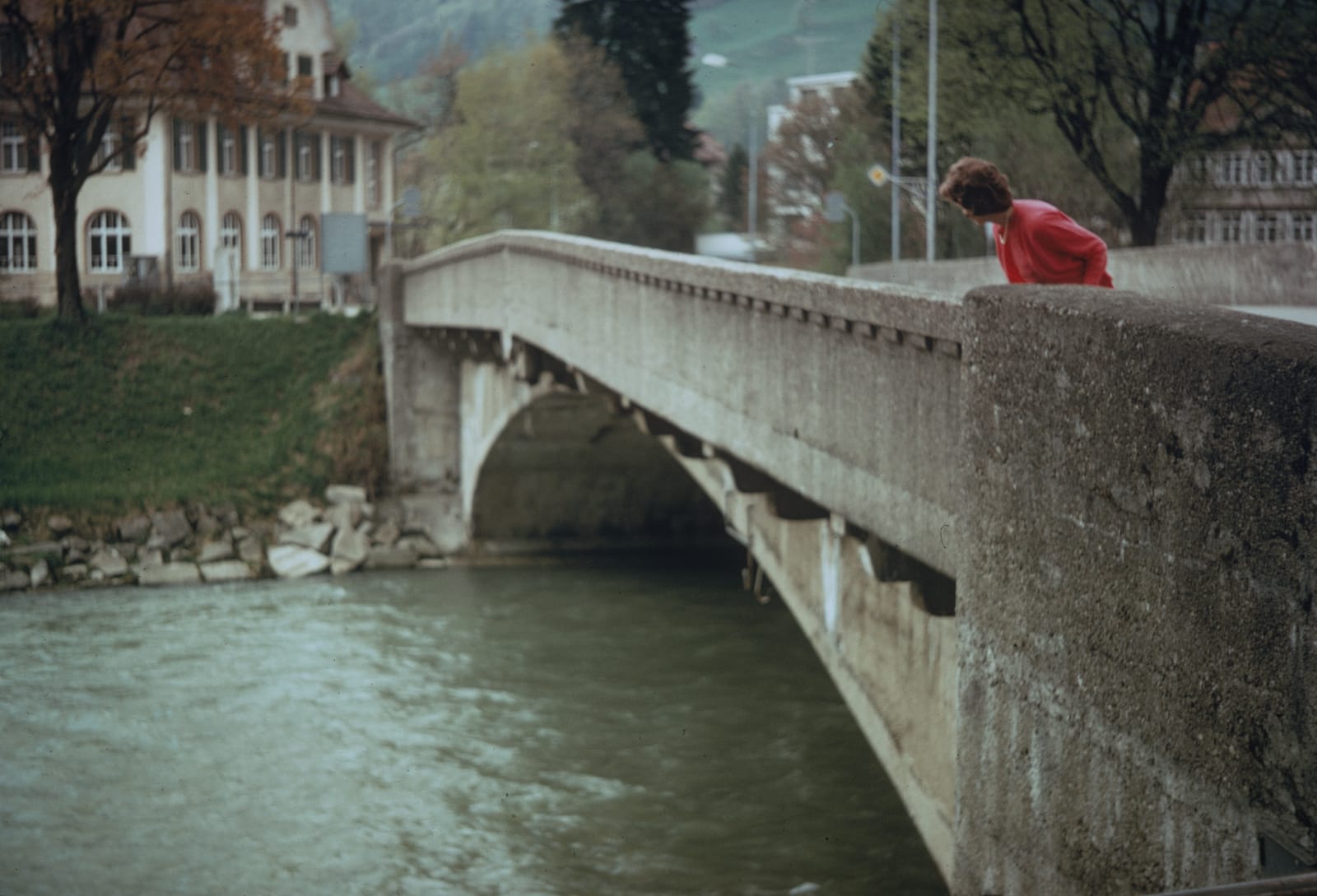
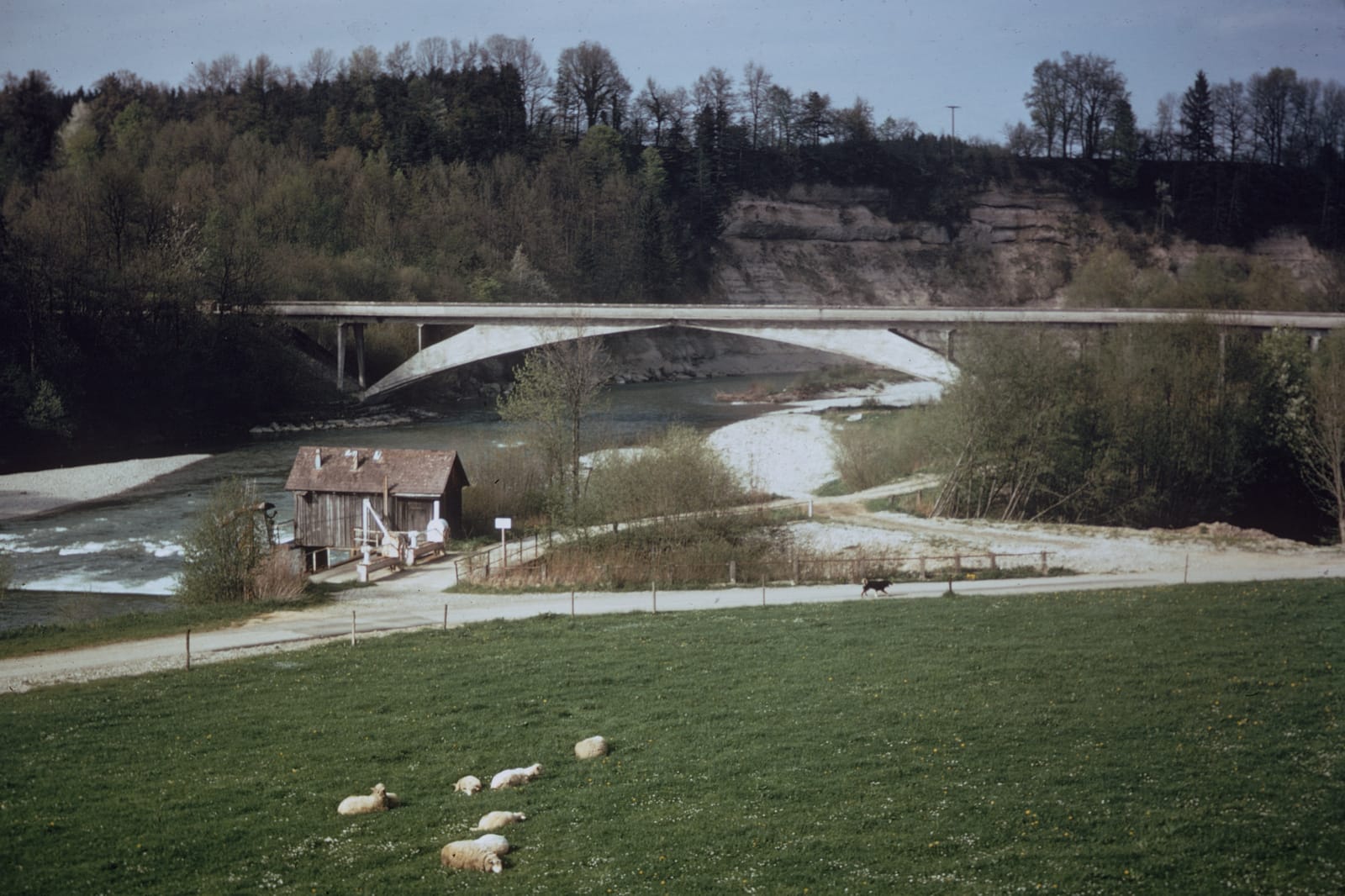
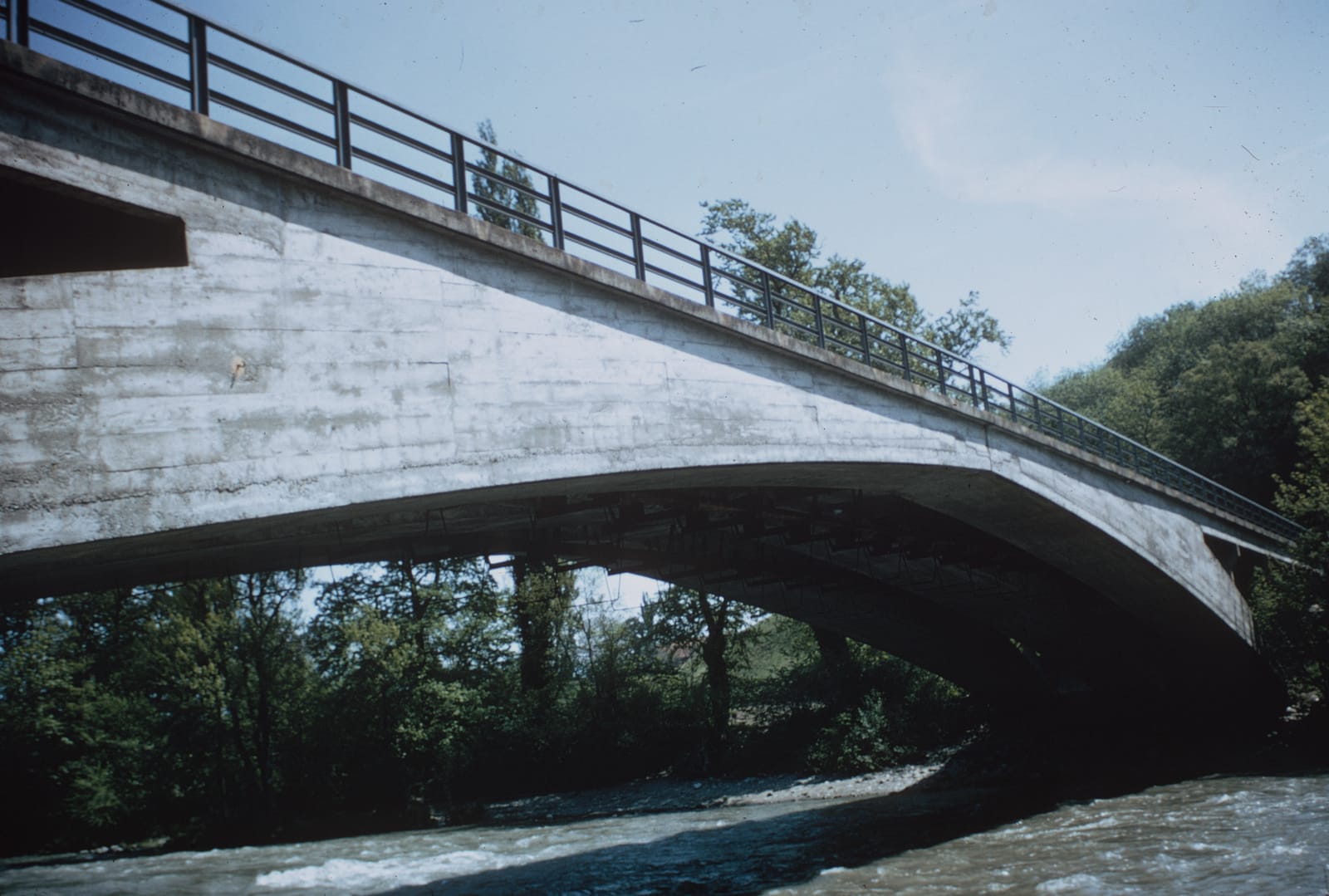
The other bridge to know is the Schwandbach Bridge (1933), about two hundred kilometres west of Salginatobel - across most of the country - near Hinterfultigen in the canton of Bern. It is smaller. To my eye, it is also the more graceful one.
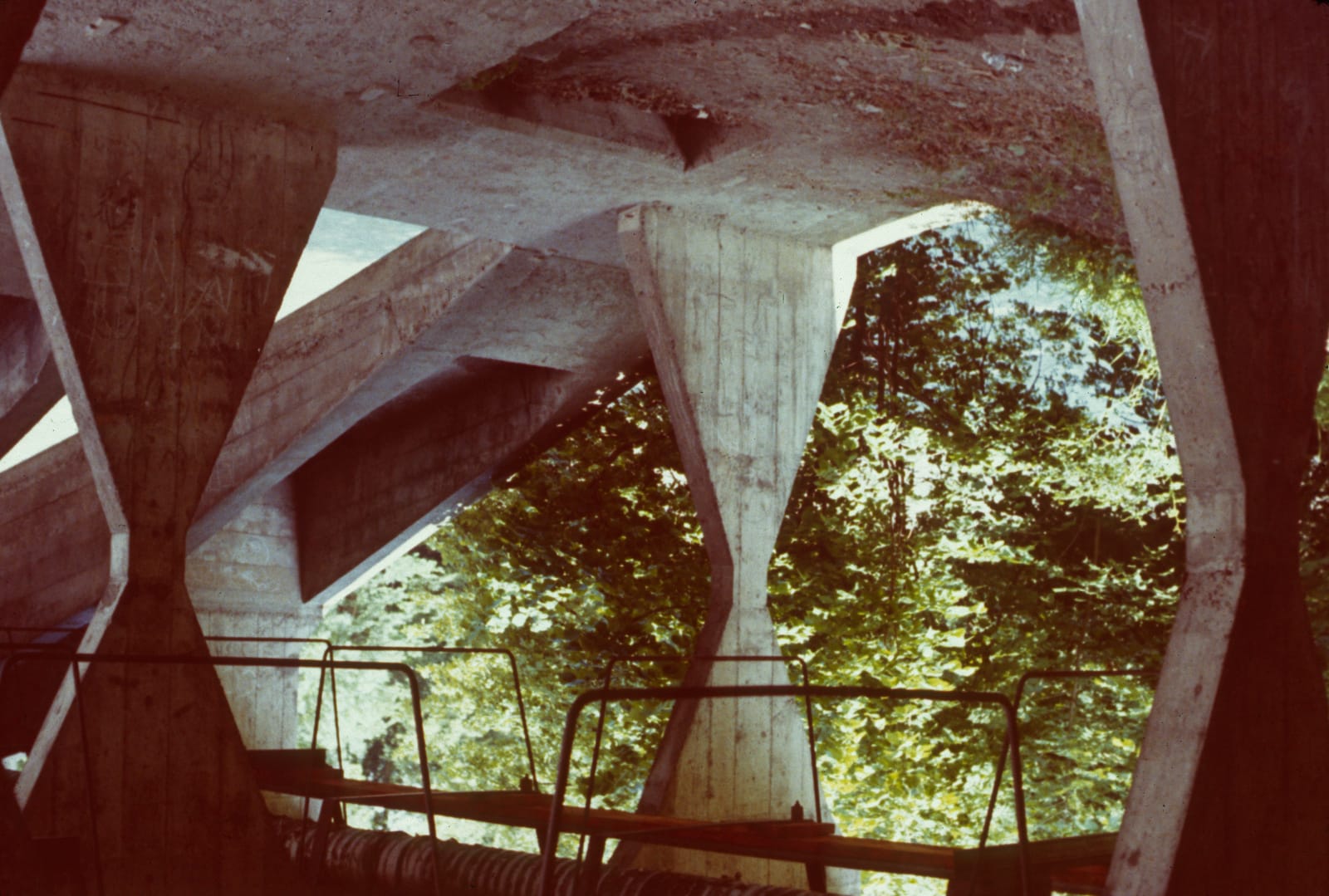
// Fotos: Billington, David P. (1927-2008) - ETH Library Zurich, Image Archive
The deck curves in plan - the road comes in around a bend and crosses a ravine - and Maillart let the curve do structural work. The arch beneath is straight in plan but thin in section; the curving deck stiffens it from above. From below, the curved deck and the slender arch appear in the same view; the whole structure reads as one act of intelligence. I think this is the most beautiful concrete bridge anyone has ever built.
Then there is the Cement Hall - the 1939 Schweizerische Landesausstellung pavilion in Zürich, designed with the architect Hans Leuzinger. It lived for a few months as a parabolic-catenary concrete shell only six centimetres thick and 11.7 metres tall. Almost nobody alive saw it. It exists now only in photographs and a model at the gta archive at ETH. After the exhibition closed in 1940 the shell was deliberately tested to destruction - loaded until it broke - so that engineers could measure exactly what a six-centimetre concrete shell could do. That is the temperament. The pavilion was built to be learned from, then given away.
Behind the bridges and the pavilions are three patents that ran underneath the whole career.
The three-hinged hollow-box arch - first built at the Zuoz Bridge over the Inn River in 1901, refined and rebuilt at Tavanasa in 1905 - a reinforced-concrete arch with hinges at the abutments and the crown that make the structure forgiving of foundation movement, with a hollow cross-section that uses about a third less material than a solid arch. Tavanasa was destroyed on 25 September 1927 when, after a night of heavy rain, a landslide poured down the hillside above the village, took the bridge with it, and killed seven people. Concrete debris analysed afterwards by Professor Mirko Roš showed the material was undamaged; the bridge had not failed. The mountain had taken it.
The mushroom slab, already mentioned - the patent of January 1909 - which lives now in every flat-plate concrete building on the planet.
The deck-stiffened arch, refined in the 1920s and brought to its purest expression at Schwandbach. A thin arch carrying a deep, rigid roadway slab. Conventionally an arch must be massive enough to handle asymmetric live loads; Maillart's insight was to stiffen the deck, not the arch. The deck distributes asymmetric loads along its full length, and the arch can be reduced toward its bare-minimum compression line.
Three patents and one principle: correspondence between shape and force. Conventional concrete construction in 1900 imitated the proportions of stone and timber - masonry-like piers, beam-and-slab framing, solid-web arches. Maillart did not. He looked at concrete as concrete and asked where the load was, and made the shape go there. The shape is the load path; the load path is the shape.
What stays with you
What lasts about Maillart is not the efficiency. He was efficient. Nor the elegance. He was elegant. It is that he never traded. He never said this version costs more but it looks better. He never said this version is uglier but it is cheaper. He found the version that was both, and the reason he could find it is that he saw concrete clearly.
He saw it as concrete. Not as stone, not as timber, not as iron. Most engineers in 1900 imitated the proportions of what they already knew. Maillart did not. Make it thicker where the load is. Make it thinner - or hollow, or absent - where the load is not. The shape of the bridge is the answer to that question. That clarity is the thing.
There is also the matter of place. Each of Maillart's surviving works sits in a specific Swiss landscape and depends on it. Salginatobel is in a high alpine gorge above the village of Schiers, in the Prättigau. Schwandbach is gentler ground near Hinterfultigen in canton Bern - pasture, a few houses, the small valley of the Schwandbach stream - and the deck's curve in plan reads against the rolling topography. The Giesshübel warehouse is in central Zürich, in an industrial quarter near the rail tracks. The work is not a portable canon. It is Swiss soil, Swiss stone, Swiss carpentry, and it was built by a Swiss-trained engineer with Swiss-trained craftsmen for Swiss-cantonal clients.
In 1991, sixty-one years after it opened, the Salginatobel Bridge was named an International Historic Civil Engineering Landmark by the American Society of Civil Engineers - the thirteenth structure so honoured, and the first concrete bridge in the world to receive the designation.
Where to go, what to read
To see Salginatobel. Take the train to Schiers in the Prättigau. From the station, the Historic Circular Path Salginatobel Bridge is signposted; the official route is described on MySwitzerland. The walk takes about two hours and ten minutes, mountain hiking grade T2, and follows the old Schuderser mule track up one side of the gorge to the bridge and back down the other. Good footwear matters. There is a viewing platform on a rocky outcrop opposite the bridge; depending on rockfall conditions it may or may not be open.
To see Schwandbach. Take the train to Bern, then the local bus toward Hinterfultigen. The bridge is forty minutes by public transport from central Bern. The road across it carries light traffic; the bridge is accessible on foot from the road.
To see Giesshübel. The warehouse is in Zürich, ten minutes' walk from Zürich Wiedikon railway station. It is still in use. You can stand inside it and look up at the column capitals.
The books, in order:
- Bill, Max. Robert Maillart: Brücken und Konstruktionen / Bridges and Constructions. Verlag für Architektur, Erlenbach, 1949. The first monograph; bilingual, with Bill's own plates.
- Billington, David P. Robert Maillart's Bridges: The Art of Engineering. Princeton University Press, 1979. The book that names the tradition.
- Billington, David P. Robert Maillart: Builder, Designer, and Artist. Cambridge University Press, 1997. The fullest biography in English.
The Princeton Maillart Archive holds Billington's curated documents online. ETH-Bibliothek e-Pics has the period photographs of Salginatobel - including Coray's timber falsework spanning the gorge in 1929, an image that should be more famous than it is.
A short tour of his most famous works
Chronological. With one exception, all in Switzerland. Click any location to open it in Google Maps.
- Zuoz Bridge (over the Inn River - the first concrete hollow-box arch, 38 m span) - Zuoz, Graubünden. 1901. 📍 Open in Maps
- Tavanasa Bridge (destroyed by a landslide on 25 September 1927; the bridge there now is a 1928 replacement by Walter Versell) - Tavanasa, Graubünden. 1905. 📍 Open in Maps
- Giesshübelstrasse Warehouse (the mushroom-slab debut - still standing, still in use) - Giesshübelstrasse, Zürich. 1910. 📍 Open in Maps
- Aarburg Bridge (over the Aare) - Aarburg, Aargau. 1912. 📍 Open in Maps
- Salginatobel Bridge (the icon) - Schiers, Graubünden. 1929-30. 📍 Open in Maps
- Felsegg Bridge (over the Thur - twin parallel three-hinged arches, 68 m span) - Henau, St. Gallen. 1933. 📍 Open in Maps
- Schwandbach Bridge (deck-stiffened arch, curved in plan) - Hinterfultigen, Bern. 1933. 📍 Open in Maps
- Töss River Footbridge (prestressed-concrete pedestrian arch) - Wülflingen (Winterthur), Zürich. 1934. 📍 Open in Maps
- Liesberg Bridge (beam bridge over the Birs with haunched columns) - Liesberg, Basel-Landschaft. 1935. 📍 Open in Maps
- Vessy Bridge (over the Arve - three-hinged hollow-box with X-shaped cross-walls) - Veyrier, Geneva. 1936-37. 📍 Open in Maps
- Cement Hall (Zementhalle) (demolished 1940; site approximate, on the Zürichhorn lakefront where the 1939 Swiss National Exhibition was held) - Zürich. 1939. 📍 Open in Maps
References
- Robert Maillart - Wikipedia. Biography, family, return from Russia (25 March 1919).
- Salginatobel Bridge - Wikipedia. Span, dates, contractor, ASCE designation 1991.
- Salginatobel Bridge - Structurae. Total length 133 m, opened 18 August 1930.
- Salginatobel Bridge - ASCE Historic Landmarks. 13th International Historic Civil Engineering Landmark; first concrete bridge so designated.
- Zuoz Bridge - Wikipedia. First concrete hollow-box arch, 1901.
- Tavanasa Bridge - Wikipedia. Construction 1905; destruction by landslide 25 September 1927.
- Tavanasa Bridge - Engineering Timelines. Roš's analysis of the debris.
- Giesshübelstrasse Warehouse - Structurae. The 1910 mushroom-slab debut.
- 1910: Reinforced Concrete Mushroom Column - AE History. Patent No. 46 928, 20 January 1909.
- Felsegg Bridge - Britannica. Twin parallel three-hinged arches, 68 m, 1933.
- Vessy Bridge - Britannica and Vessy Bridge - Structurae. 1936-37.
- Liesberg Bridge - Britannica. Beam bridge with haunched columns, 1935.
- Töss River Bridge - Britannica. 1934.
- Cement Hall (Zementhalle) - Structurae. Co-design with Hans Leuzinger; 6 cm shell; demolished 1940; load-tested to destruction.
- Cement Hall construction - RIBA pix. Period construction photographs.
- Salginatobel Bridge - MySwitzerland. Walking trail and access information.
- Bill, Max. Robert Maillart: Brücken und Konstruktionen. Verlag für Architektur, Erlenbach, 1949. The original constructive characterisation.
- Billington, David P. Robert Maillart: Builder, Designer, and Artist. Cambridge University Press, 1997. Biographical detail and the Russian period.
